

The F3 Methodology™
Kid-centered · Screen-free · Developmentally aligned
F3, the Foundational Future Framework, is a method for teaching STEM and AI that puts the child at the center, matches every experience to how young minds develop, and builds the thinking behind technology before a screen ever turns on. It powers every KidGeeniers program and is designed for any school, center, or educator ready to adopt it.
Children reached
Core principles
Learning stages
Languages, one method
STEM.org Accredited and recognized among the Top 5% Best in STEM
Four principles, one center
When we say kid-centered, we mean the child is the nucleus of the method. Every experience is shaped around their cognitive readiness, emotional balance, and curiosity: discovery over memorization, projects sparked by their own questions, and a pace that respects attention spans and emotional rhythms.
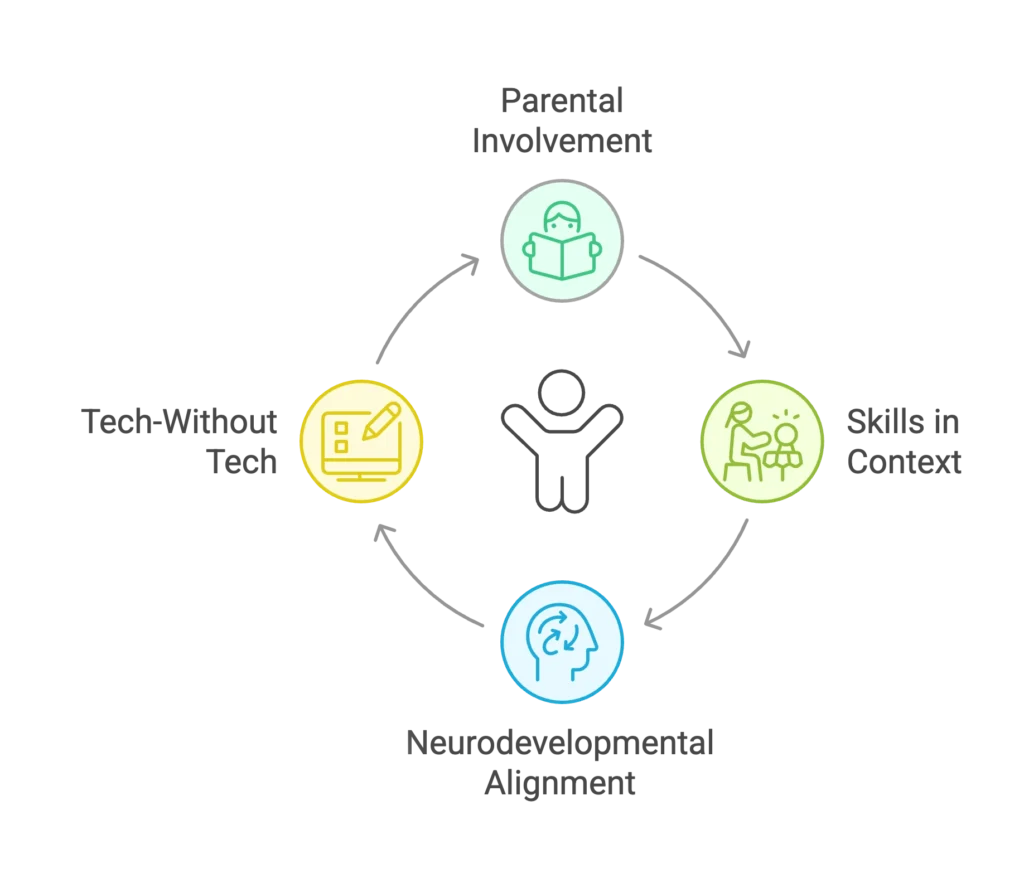
Parents are partners, not spectators.
Children’s relationship with technology is shaped at home as much as in class. F3 gives parents the language and tools to guide that relationship with confidence, so what children learn in a session keeps growing at the kitchen table.
In practice
Knowledge matters when it connects to real life.
We blend STEAM disciplines with the human skills that make them useful, like creativity, collaboration, and communication, and place them in real situations. Children explore, question, and apply what they learn to everyday challenges, and discover that learning is a tool to understand and improve their world.
In practice
The right challenge at the right moment.
Every activity is matched to the child’s cognitive and emotional stage. When a challenge fits a child’s natural readiness, understanding goes deeper and lasts longer. Developmental stages guide our design, and each child’s own pace sets the rhythm.
In practice
Understand technology before depending on it.
We love technology, and we want children to use it well. Through play, hands-on challenges, and unplugged activities, children build the logic, problem-solving, collaboration, and imagination that technology demands. When their screen moment arrives, they already know how to think, question, and create with balance and purpose.
In practice
The architecture
F3 moves through four learning stages. Each one builds on the last, taking children from naming what technology is to using it to shape what comes next. The stages draw on developmental research, including the work of Jean Piaget and Erik Erikson, and work as a guide rather than a box: every child moves at their own pace.

Curriculum focus: The “What”
Children at this age are moving from intuitive thinking toward logical reasoning, what Jean Piaget described as the shift from the preoperational to the concrete operational stage. Their logic is still tied to what they can see and touch, so they learn best through play, stories, and hands-on activities.
How they think and learn
What F3 does at this stage: We introduce technology concepts and give children the words to name them.
Curriculum focus: The “How”
Children are now firmly in the concrete operational stage. They understand cause and effect, classification, and systems. It’s the golden age of project-based learning: a growing sense of competence, what Erik Erikson called industry, drives them to build and achieve.
How they think and learn
What F3 does at this stage: Children apply their skills with real tools in projects that produce something they can hold, test, and share.
Curriculum focus: The “Why”
Young teens are entering Piaget’s formal operational stage, the shift toward abstract thinking. They reason about hypothetical situations, explore ethics, and think about the future, while building their identity and seeking connection and real-world impact.
How they think and learn
What F3 does at this stage: We explore the impact and ethics of technology, and what it means for people and communities.
Curriculum focus: “What’s Next”
Teens can now handle complex abstract thought and long-range planning. Their attention turns toward college, careers, and making a tangible difference in the world.
How they think and learn
What F3 does at this stage: Teens apply what they know to real-world challenges and innovation, connected to their goals and their community.
The cognitive map
F3 doesn’t start from content. It starts from how the brain matures. The cognitive map follows 37 cognitive and socio-emotional skills across nine domains through the four learning stages, and it decides the sequence: a technical concept enters a stage only when the skills it depends on are ready, so children understand it instead of memorizing it. Ages are a guideline; each child’s actual stage is confirmed with the F3 Tier Diagnostic Card.
For every stage, each skill is assessed on the same five-step scale. The scale tells us not just whether a child can do something, but how ready the brain is to build on it.
The skill is practically absent or unobservable. The brain structures it needs aren’t available yet.
First contact and experimentation. Used inconsistently, and depends on context and adult support.
Actively under construction. Visible progress and frequent errors. The state most sensitive to outside influences.
Acquired and being refined. Applied with some autonomy and stable under normal conditions.
Consolidated. Applied with flexibility and confidence in complex or new situations.
The cognitive map is the referee of the sequence. Take abstract reasoning and the AI thread of the curriculum: the same idea appears in every stage, at the depth the brain can support.
Abstract ideas like algorithmic bias can’t be genuinely understood yet, so they wait. Explorers learn that an algorithm is an exact sequence of steps a machine follows: it doesn’t guess, and it doesn’t interpret.
Analogical reasoning is under construction, so abstractions work when they’re anchored to concrete examples: systems that produce text, images, or code from human input.
Hypothetical-deductive reasoning is developing, so teens can explore how a network learns (layers, weights, and activation) at a conceptual level.
Critical synthesis and systems thinking have matured, so Creators can reason about how an AI system is designed, trained, deployed, and governed end to end.
A simplified view of how each domain typically progresses from Explorers to Creators, based on the average of its skills. Taller, darker bars mean a more consolidated domain.
Steady progress. Executive functions keep maturing into early adulthood (around age 25).
Starts late: abstract reasoning is only beginning to emerge before age 12.
The 9–14 window is highly sensitive to social comparison and digital anxiety.
The most solid, steady upward trajectory of all nine domains.
Erikson’s identity crisis coincides with the Development state.
Reasoning from universal principles takes shape in the Leaders stage.
The only domain in decline: it atrophies with heavy screen use.
Risk assessment matures at the pace of the prefrontal cortex.
Deep reading and reflective writing suffer under infinite scroll.
This is when the most skills are under construction, in the state most sensitive to outside influences. It’s also when most kids get their first smartphone, around age 10 in the U.S. That’s why F3 builds understanding before tooling in these years.
Symbolic play, divergent thinking, unstructured free play, and boredom tolerance can weaken with heavy screen use. That isn’t a developmental failure. It’s atrophy caused by screens replacing the experiences that build these skills.
Evidence behind the map: developmental psychology and neuroscience (Piaget, Erikson, Kohlberg, Vygotsky), research on executive functions (Diamond; Miyake) and intelligence (Sternberg), and current evidence on how the digital environment affects children (Haidt, Lembke, Suskind, Hirsh-Pasek).
The skill-by-skill matrix behind this map, the Tier Diagnostic Card, and how to design experiences for each stage are taught to certified F3 practitioners.
Skills in context
Our focus is always on the child. Real empowerment comes not only from learning a skill but from understanding its power and purpose in their own world. The skills we teach are technical. Our method is deeply human.
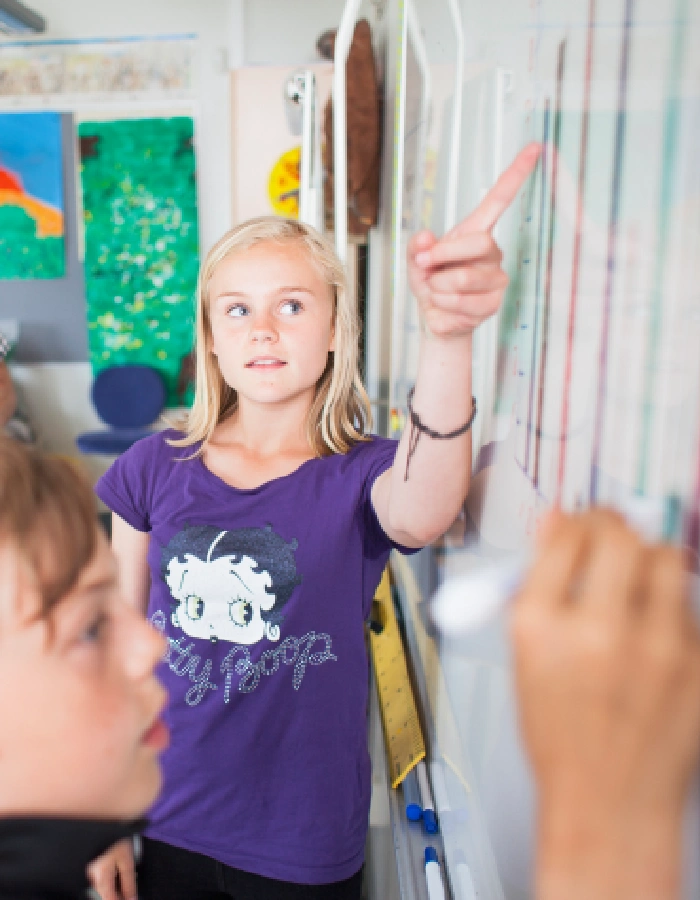
We give children the vocabulary to name their abilities, from data analysis to ethical design, so they can explain what they know with confidence.
Every skill connects to a purpose they care about. Cybersecurity isn’t a lecture. It’s how you protect your ideas and keep your friends safe online.
Learning lives in their reality. Project management isn’t a business chart. It’s how you plan a surprise party or win a robotics challenge.
Children apply each skill to projects they care about, turning abstract ideas into creations they’re proud of.
Why these skills
Tools change every few years. The ways of thinking behind them don’t. F3 builds the foundation every future skill rests on, the same capabilities employers and education systems now name as essential.
Breaking problems into steps, spotting patterns, and reasoning with evidence. The World Economic Forum’s Future of Jobs Report 2025 names analytical thinking the top core skill, essential for seven in ten employers.
Imagining what doesn’t exist yet and staying eager to learn. The same report lists creative thinking, curiosity, and lifelong learning among the skills rising in importance through 2030.
Self-regulation, empathy, and collaboration make every other kind of learning possible. A meta-analysis of 213 school programs and more than 270,000 students found that social-emotional learning raised academic achievement by 11 percentile points.
AI and big data are the fastest-growing skills in the WEF outlook. F3 pairs that literacy with ethics and balance, so children understand technology, question it, and use it responsibly.
The foundations
F3 wasn’t invented from scratch. Each principle translates well-established research in child development and education into everyday practice with children and families.
Neurodevelopmental Alignment
Jean Piaget showed that children’s reasoning develops in stages. Lev Vygotsky showed that they learn most just beyond what they can do alone, with the right support. Erik Erikson described how motivation shifts as identity grows. F3 uses these ideas to match each challenge to a child’s readiness and scaffold every step.
Key sources: Piaget’s theory of cognitive development; Vygotsky’s zone of proximal development; Erikson’s psychosocial stages
Skills in Context
John Dewey argued that children learn through meaningful experience, not memorization. Seymour Papert, a pioneer of children’s computing at MIT, showed that they learn best by building things they care about. F3’s project-based, inquiry-driven sessions put both ideas to work.
Key sources: Dewey, Experience and Education (1938); Papert, Mindstorms (1980)
Tech-Without Tech
Jeannette Wing described computational thinking as a fundamental skill for everyone, not only programmers. A 2023 meta-analysis found that unplugged, screen-free activities have a large positive effect on children’s computational thinking.
Key sources: Wing, “Computational Thinking,” Communications of the ACM (2006); International Journal of STEM Education meta-analysis (2023)
Parental Involvement
Meta-analyses by William Jeynes link parental involvement with higher academic achievement among elementary school students. F3 turns that finding into practice through co-learning at home and reflection sessions for parents.
Key sources: Jeynes, Urban Education (2005); Jeynes, Urban Education (2012)
In practice
Research gives F3 its foundation. Classrooms, families, independent reviewers, and our own practitioners keep it honest.
F3 has shaped learning for children across Mexico, the United States, Peru, and Colombia, in two languages.
KidGeeniers holds the STEM.org Accredited™ Experience trustmark, ranks among the Top 5% Best in STEM, and is endorsed by Doctrina Qualitas.
Educators earn F3 certification through a structured path, from Practitioner to Master, with evidence-based assessment of their practice.
The F3 Master program includes a module where practitioners examine the framework’s own assumptions and limits.
Questions about F3 or its research base? Talk to our team
©2026. All rights reserved by Silicon Valley Futures Institute LLC